

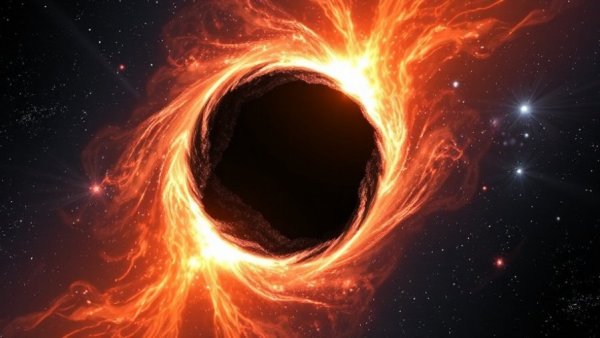
The Groundbreaking Theory of Black Holes
Recent research has ignited curiosity in the scientific community as it proposes a radical new theory: the potential for black holes to split in two. Traditionally, black holes are understood to merge rather than divide, which makes this discovery not just intriguing but revolutionary. The implications of a fast-spinning black hole dividing could alter our understanding of the cosmos fundamentally.
Understanding Black Hole Mechanics
To appreciate the significance of this discovery, we must first grasp how black holes work. These dense celestial objects are remnants of massive stars and possess an intense gravitational pull that not even light can escape. Ordinarily, when two black holes collide, they combine into a larger black hole, an event confirmed by gravitational wave detection technology. The proposition that they could divide creates a new paradigm for exploring their properties and behaviors.
Thermodynamics in Play
A central challenge in the prospect of black holes splitting lies within the domain of thermodynamics. Entropy plays a crucial role in the stability of these celestial bodies. Black holes, characterized by their immense entropy, resist division due to the inherent rule that a system's entropy cannot decrease without an external influence. However, researchers led by Francesco Sannino from the University of Southern Denmark suggest that extreme rotational speeds might offer a loophole, creating conditions that could allow for such a separation.
Fast-Spinning Black Holes: A Unique Opportunity
The mechanics of a rapidly spinning black hole could lead to unprecedented cosmic phenomena. As the study hints, if a black hole rotates at near-maximum speed, it creates a theoretical framework where splitting could occur. This invites an engaging discussion about the types of cosmic events that telescopes might discover in the future. Would they capture this division in action? The universe may be offering us ways to observe phenomena previously thought impossible.
The ‘Pair-of-Pants’ Topology
The research team also introduced a unique analogy to visualize this theoretical process: the 'pair-of-pants topology.' Imagine the event horizon of a black hole as a single structure that morphs into two distinct branches over time. This unusual geometric representation not only provides clarity about the process but encourages scientists to rethink their models concerning black holes. It showcases how an event horizon can evolve dynamically. Other models always assumed black holes maintained their structures; this indicates a more fluid state may exist.
Future Implications and Observational Opportunities
What if this theory gains traction? For astronomers and physicists, this finding opens new avenues for exploration. The detection of such events could influence our understanding of gravitational waves, potentially leading to a Renaissance in astrophysics. Telescopes might soon analyze not only mergers but also separations, reshaping our cosmic narrative.
Connecting to Dallas: Living in a Scientific Frontier
Residents of Dallas and surroundings can take pride in the continued significance of their region in the scientific community. Educational institutions and innovation initiatives are continuously fueling the landscape, providing resources and opportunities for budding scientists and tech enthusiasts. Organizations in Dallas are aware of the exciting implications of such research, allowing local influencers to spread awareness and foster appreciation for scientific advancements like these.
What This Means for Us
This new theory not only pushes the boundaries of theoretical physics but also encourages diverse discussions around the world of astrophysics. For science enthusiasts, the contemplation of tangible phenomena like black holes splitting encourages various practical considerations, ranging from educational programs to community discussions about the universe's mysteries.
Conclusion: Science Reimagined
This revealing study raises more questions than answers, but that’s the beauty of scientific exploration. By challenging long-standing beliefs, it inspires curiosity and innovation. Keep your eyes on the stars; the heavens may soon divulge even more thrilling secrets by shifting what we believe about their nature.




Write A Comment