

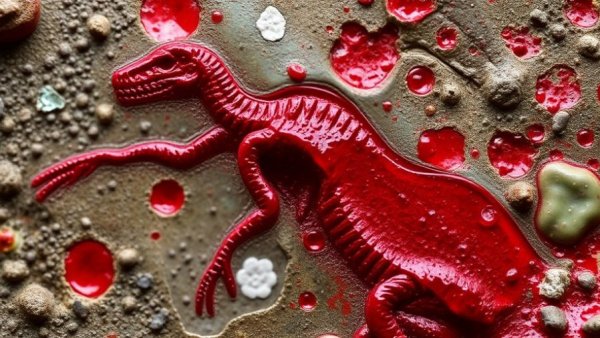
The Astonishing Discovery: Dinosaur Blood Survives for Millennia
In a groundbreaking revelation, scientists have unearthed traces of dinosaur blood that have remarkably survived for 115 million years, smashing previous records of biological preservation. This impressive finding not only reshapes our understanding of the longevity of biological molecules but may also offer insights into dinosaur physiology that were previously unobtainable. The research, led by a collaborative team from Curtin University in Australia, has significant implications for fields ranging from paleontology to astrobiology.
Preserving Biological Remains: The Science Behind Dinosaur Blood
The discovery centered on the bones of Aratasaurus museunacionali, a theropod dinosaur discovered in northeastern Brazil. For the first time, researchers were able to chemically confirm the presence of blood-derived molecules, including hemoglobin components in fossilized red blood cells. This achievement is notable as previous studies had only hinted at the existence of such structures without definitive proof.
Professor Kliti Grice, leading the study, highlighted how the mineral hausmannite may have played a pivotal role in stabilizing and preserving the blood cells for eons. This mineral acted like a natural time capsule, protecting the delicate biological materials against the elements that would typically lead to their decomposition.
Why This Research Matters: Implications for Science
This phenomenal discovery extends the fossil record of blood, fundamentally altering how researchers will approach the study of ancient life forms. Beyond paleontology, the implications of this research stretch into astrobiology. The resilience of biological materials raises intriguing questions about the possibilities of life beyond Earth, as scientists look to ancient biological detections on other planets.
Environmental Context: Conditions that Favor Preservation
The specific conditions surrounding the burial of the dinosaur played a crucial role in preserving its biological materials. Rapid coverage by sediment and an anaerobic environment (with limited oxygen) minimized decomposition risks, allowing for the unprecedented preservation of such fragile molecules. This finding underscores the significance of burial conditions in fossilization, which could enhance our understanding of similar processes on other planets.
Future Predictions: What Lies Ahead for Dinosaur Research
With this discovery setting a new benchmark in paleontological research, one can predict a surge in similar investigations aimed at uncovering biological remnants from the past. Studies might focus on further understanding the physiological attributes of dinosaurs and how they adapted to their environments. Additionally, the techniques developed in this research may assist in future explorations of potential ancient microbial life on extraterrestrial bodies.
Targeted Insights for the Curious Reader
As we delve into the realms of ancient life through the lens of modern science, it's imperative to recognize how such findings enrich our understanding of evolution and life's adaptability. The potential for discovering ancient organisms on Earth—and perhaps other planets—reminds us of the interconnectedness of all living things, transcending time and space.
Call to Action: Join the Quest for Knowledge
As we continue to unlock the mysteries of the past, consider taking part in discussions or support organizations dedicated to paleontological studies. Engaging with these communities not only fosters a deeper appreciation for our planet's history but also fuels further discoveries that could reshape our understanding of life itself.





Write A Comment