

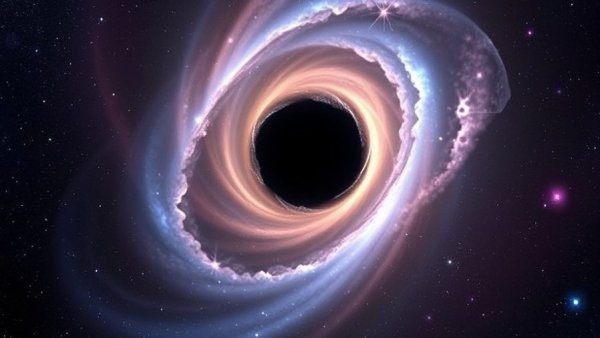
Exploring the Mystery of Silent Black Holes
Recent scientific discoveries are shaking up our understanding of black holes. New research reveals that many of these enigmatic cosmic entities may form from massive stars collapsing silently, rather than exploding in a dramatic supernova. This research, led by the California Institute of Technology, reveals a 'mysterious gap' in the characteristics of these black holes, hinting at a new population that has never been directly observed.
The study highlighted data from gravitational wave observations collected by LIGO, Virgo, and KAGRA, which measured 257 black hole mergers over the past decade. This data suggests that these black holes share a common origin, potentially emerging from stars that simply vanish without the expected explosive finale. According to Katerina Chatziioannou, a Caltech physicist, this may represent a previously unrecognized subpopulation of black holes that failed to explode.
The Implications of Quiet Stellar Death
Understanding how black holes are formed is crucial to unraveling the broader mysteries of the universe. Traditionally, stars much bigger than our sun are thought to end their life in spectacular supernovae, dispersing their remnants across space. However, this new theory posits that some might collapse under their gravity without any visible explosion. This could explain why scientists have been perplexed by the presence of these black holes—many of which are approximately ten solar masses—which don't fit neatly into the conventional models of stellar evolution.
A Pattern Unveiled in Black Hole Mergers
The new findings are driven by innovative research techniques utilizing gravitational wave astronomy. Until the LIGO's breakthrough in 2015, black holes remained largely theoretical, visible only through their gravitational effects on surrounding objects. With over 300 observed mergers to date, scientists connect emerging data patterns with predictions surrounding the lifecycle of massive stars. The prominent 'gap' observed in black hole mass distributions may be evidence that supports the silent collapse theory. In other words, the universe may harbor more black holes than traditional models can account for.
The Future of Astrophysical Research
This research has significant implications for future studies. If the existence of these silent black holes is confirmed, it will reshape our knowledge of stellar evolution, gravitational waves, and the overall structure of black holes in the universe. As scientists continue to piece together this cosmic puzzle, the potential to unlock new insights into the forces that govern our universe arises.
Connecting the Dots: How This Affects Us
While these findings seem distant from our everyday lives, they invite a broader philosophical inquiry about our place in the universe. As we delve deeper into understanding phenomena beyond our planet, we emerge with a greater appreciation for the complexities of nature and its workings. Moreover, advancements in technology and studying black holes drive innovation in sectors ranging from data analysis to AI, demonstrating the interconnectedness of disparate fields.
Final Thoughts - Why Understanding Black Holes Matters
The research into black holes, particularly those that do not explode, opens up a new frontier in cosmic exploration. These revelations remind us of the vast unknowns lurking in the universe. So, as you reflect upon the stars at night, remember that silent mysteries may lie within those glimmering bodies above us, awaiting discovery. The depth of our universe often invites us to think beyond our familiar realms, encouraging a curiosity that transcends the barriers of everyday life in places like Dallas, where future astronauts and scientists may one day emerge.





Write A Comment